

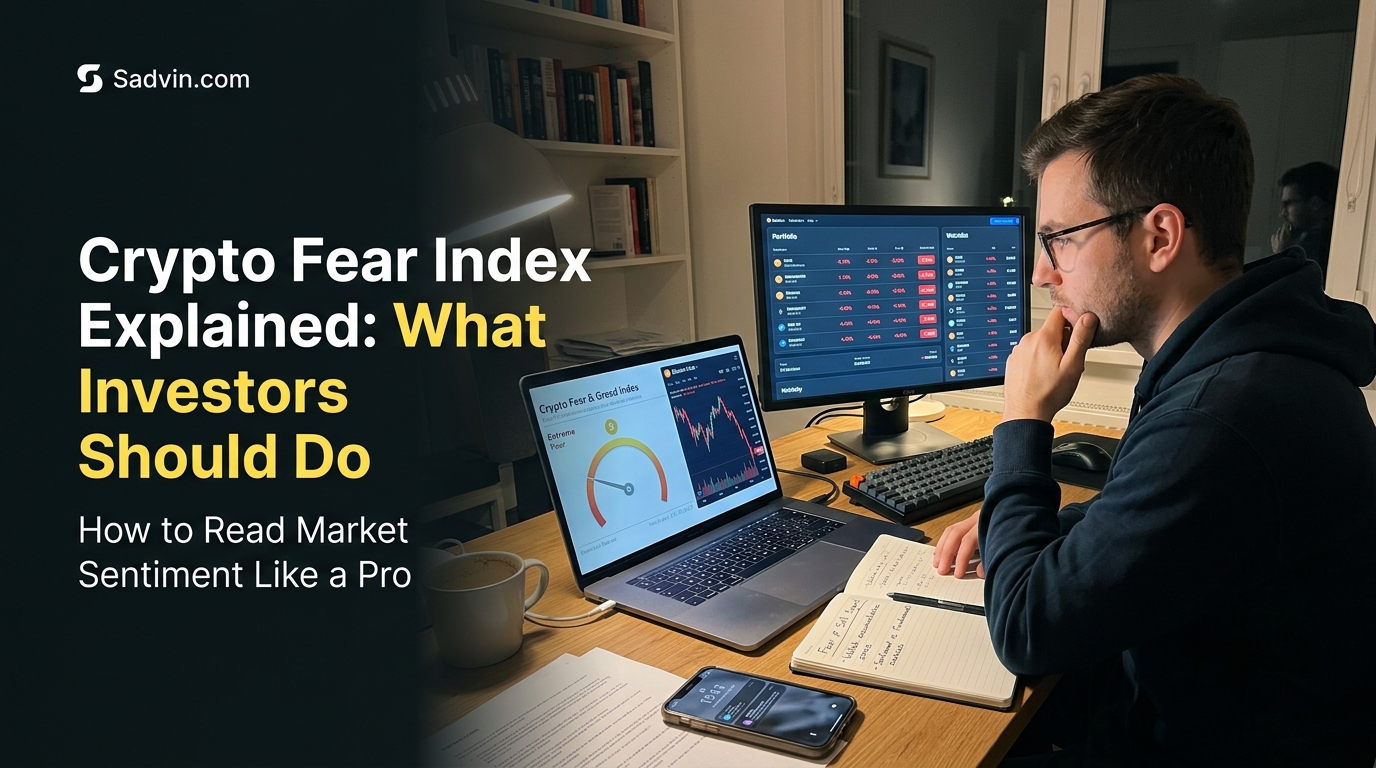
The Crypto Fear & Greed Index is a simple way to measure market sentiment in a single number from 0 to 100. A low score means fear is dominating the market, while a high score means greed and FOMO are taking over.
For investors, the index is useful because it shows when emotions may be pushing prices too far in one direction. It is not a prediction tool, but it can help you avoid panic selling in fear and overbuying in euphoria.
What the index measures
The fear index combines several market signals into one reading. Common inputs include volatility, market momentum and volume, social sentiment, Bitcoin dominance, and search behavior such as Google Trends.
Different platforms may weigh these inputs slightly differently, but the purpose is the same: to estimate whether the market is emotionally stressed or overly optimistic.
Score ranges
The index is usually interpreted in the following way:
| Score range | Meaning | Typical market mood |
|---|---|---|
| 0-24 | Extreme fear | Panic, forced selling, very cautious sentiment |
| 25-49 | Fear | Weak confidence, selective buying, uncertainty |
| 50 | Neutral | Balanced sentiment, no clear emotional bias |
| 51-74 | Greed | Growing optimism, more aggressive buying |
| 75-100 | Extreme greed | Euphoria, FOMO, higher correction risk |
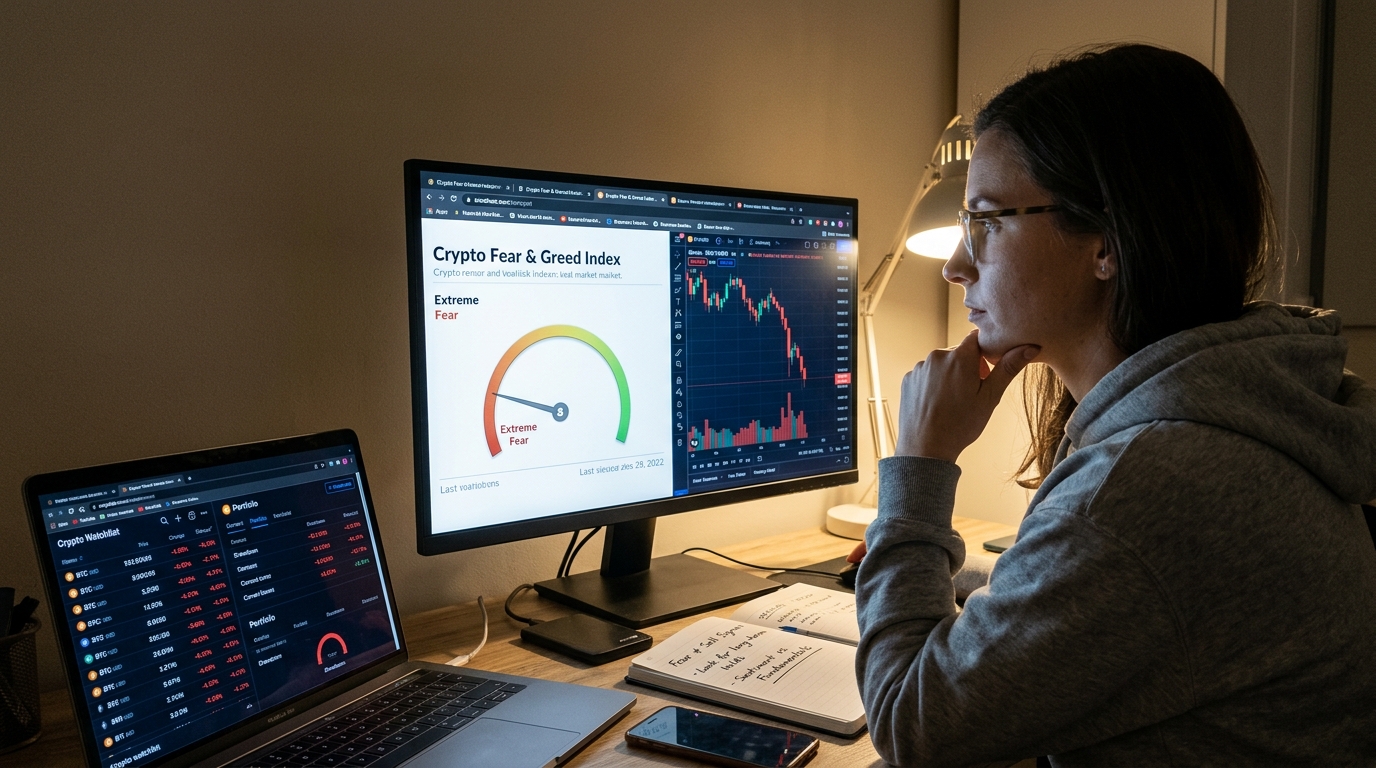
Why fear can be useful
Fear often creates opportunity because the market can overshoot on the downside. Strong assets may get sold along with weak ones, which can create better prices for patient investors.
This is why many investors look at the index as a contrarian signal. When sentiment is very low, quality assets may be undervalued relative to their long-term potential.
What the index cannot tell you
The fear index only measures sentiment. It does not tell you whether a project has strong fundamentals, real users, token unlock pressure, regulatory issues, or security problems.
That means a low reading does not automatically make every coin a good buy. A project can be cheap because of fear, or cheap because it has real problems.
What investors should do
When fear is high, the smartest move is usually to slow down and focus on quality. Panic often leads to bad decisions, while disciplined buying can improve long-term outcomes.
- Review your portfolio and separate blue-chip assets from speculative coins.
- Use dollar-cost averaging instead of going all in at once.
- Keep some cash or stablecoins ready in case prices fall further.
- Check whether the fear is caused by market emotion or a real project failure.
- Focus first on assets with liquidity, adoption, and strong survival odds.
Strategy by investor type
| Investor type | Best move during fear |
|---|---|
| Conservative | Focus on Bitcoin and Ethereum, use small staged entries |
| Moderate | Add strong altcoins with real utility and liquidity |
| Aggressive | Buy higher-beta names carefully, with strict position sizing |
| Long-term holder | Accumulate gradually and ignore short-term noise |
Common mistakes
Many investors misuse the fear index by treating it like a buy or sell signal on its own. That can lead to poor entries, emotional exits, and overconfidence in sentiment data.
- Buying everything just because fear is high.
- Selling everything just because greed is high.
- Ignoring fundamentals and token mechanics.
- Confusing a bounce with a real trend reversal.
- Going all in instead of scaling in.
How to combine it with other tools
The fear index works best when used with other indicators. Investors should combine it with support and resistance, volume, on-chain activity, project fundamentals, and macro conditions.
Used this way, the index becomes a sentiment filter rather than a prediction system. That makes it more useful and less dangerous for everyday investors.
Frequently asked questions
What is the Crypto Fear Index?
It is a sentiment gauge that scores market emotion from 0 to 100, with low values showing fear and high values showing greed.
Is extreme fear a good time to buy crypto?
It can be for strong assets, but fear alone should never be the only reason to buy.
Should I sell when the index is high?
Not automatically. High greed can be a warning sign, but fundamentals and trend context still matter.
Does the index predict the market?
No. It helps show sentiment, but it does not forecast price with certainty.
Is the fear index useful for altcoins?
Yes, but it is mainly a Bitcoin-based sentiment indicator, so altcoins should always be judged with extra caution.
Conclusion
The Crypto Fear & Greed Index is a helpful way to understand market emotion, especially during volatile periods. When fear is high, investors should not panic — they should slow down, check fundamentals, and focus on quality entries.
The best use of the index is simple: let it warn you when emotion is extreme, but never let it replace real research.
