

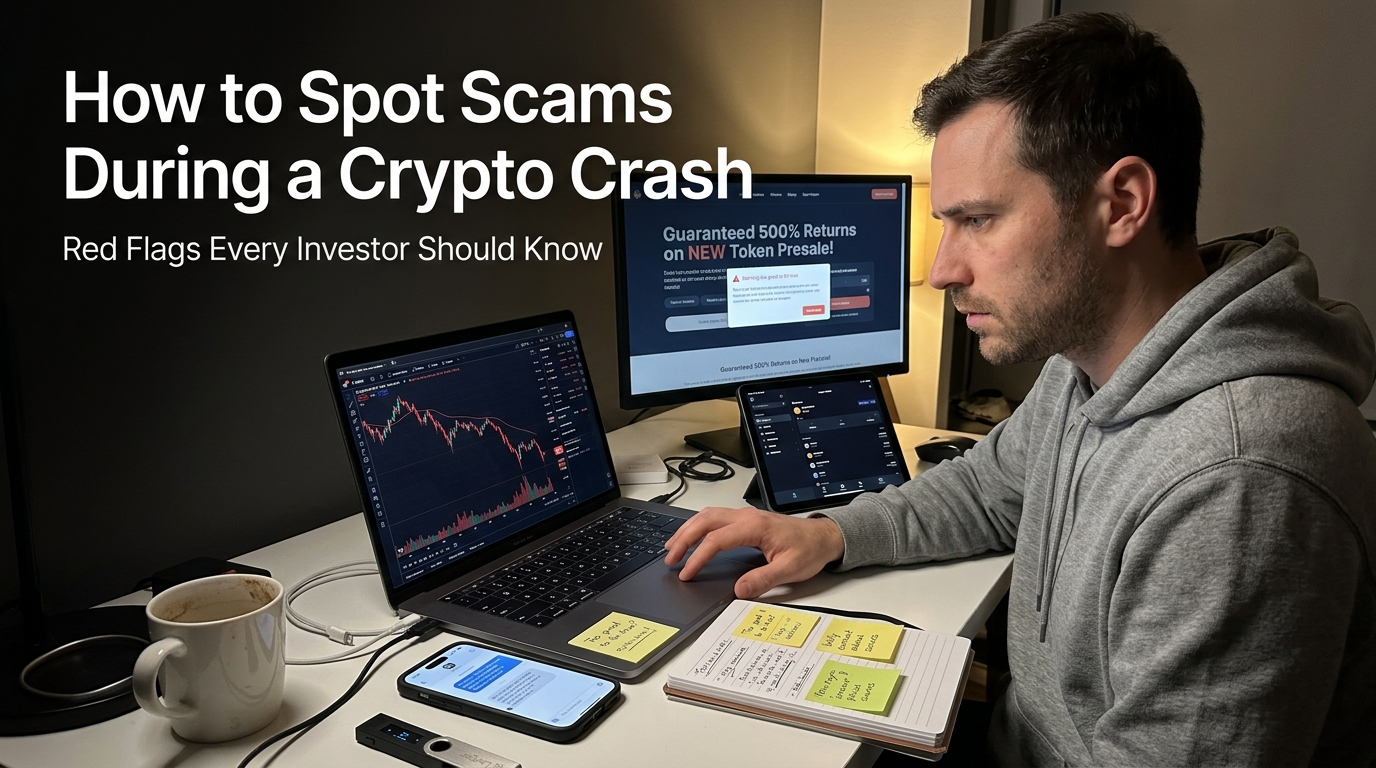
Crypto crashes do more than hurt portfolios. They also create the perfect environment for scams, because fear, urgency, and hope make people easier to manipulate. When prices fall fast, scammers know investors are more likely to click suspicious links, trust fake “recovery” offers, or chase the next supposed bargain.
This guide shows you how to spot the most common scams during a crypto crash, how scammers talk, what red flags to watch for, and what to do if you already interacted with a suspicious offer. Officials consistently warn that crypto scams often use unrealistic returns, unsolicited contact, pressure tactics, fake platforms, and recovery offers that demand upfront fees.
Why crashes attract scams
Bear markets and panic selloffs make people emotionally vulnerable. Investors want to recover losses quickly, so promises like “double your money,” “get back what you lost,” or “secret bottom signals” become more attractive than they should be. Scammers use that pressure to push rushed decisions before victims have time to verify anything.
A crypto crash also gives fraudsters a better story. They can claim they have a special method, insider access, or a recovery service that works only for a limited time. The goal is always the same: create urgency, lower your guard, and get you to send money or connect your wallet.
Most common scam types
During a market crash, the same scam patterns appear again and again. Some are new, but many are old fraud tactics repackaged for crypto.
| Scam type | How it works | Why it is dangerous |
|---|---|---|
| Fake recovery scams | Someone claims they can recover your lost crypto or help you “claw back” funds for a fee. | Victims lose more money after already being hurt once. |
| Phishing scams | Fake login pages, wallet prompts, and support links steal your credentials or seed phrase. | Scammers can drain wallets after one bad click. |
| Fake exchanges or wallets | Fraudulent platforms look real, show fake balances, and then block withdrawals. | Your deposit may disappear with no way to recover it. |
| Scam tokens and presales | New tokens promise fast recovery, big gains, or “the next 100x” during panic. | Many are pump-and-dump schemes or outright rug pulls. |
| Fake trading groups | Telegram, Discord, or social media groups claim to have secret signals or guaranteed entries. | They often sell bad calls, referral links, or fake subscriptions. |
| Impersonation scams | Fraudsters pretend to be exchange support, law firms, or recovery agents. | They use authority to pressure you into paying. |
Red flags to watch

If you notice any of the following, stop and verify before doing anything else:
- Guaranteed profits or “risk-free” returns.
- Unsolicited messages from strangers, support agents, or “recovery specialists.”
- Pressure to act immediately, before an opportunity disappears.
- Requests to pay fees in crypto, especially to unlock funds or receive help.
- Fake testimonials, copied logos, or websites that look slightly off.
- Promises that they can recover money from a previous scam.
- Social media DMs that offer “private” or “exclusive” opportunities.
- Links that do not match the official project or exchange domain.
- Requests for your seed phrase, private key, or remote access to your device.
How scammers talk in a crash
Scammers usually do not sound like scammers. They use confident language, emotional triggers, and market fear to make their message feel urgent and believable. During a crash, their wording often focuses on recovery, timing, and scarcity.
- “You are early to the rebound.”
- “We know the bottom before the market does.”
- “Recover your losses in 48 hours.”
- “Only a few spots left in the private group.”
- “Send a small fee first, then we release the profit.”
- “We can trace and recover your crypto.”
Real opportunities do not need pressure, secrecy, or fake urgency. The more someone rushes you, the more careful you should be.
How to verify legitimacy
Before you invest, connect a wallet, or send any funds, use a simple verification process. This can save you from most scam attempts.
- Open the official website manually instead of clicking a link.
- Check the project’s exact domain name and social accounts.
- Look for a real company registration, team page, and support process.
- Search for the firm name plus words like “scam,” “review,” and “complaint.”
- Verify whether the platform is actually registered or authorized in your region.
- Never share a seed phrase, private key, or one-time password.
- Never pay an upfront fee to recover funds.
If a platform only exists on Telegram, a rushed landing page, or a social media post, treat it as highly suspicious.
What to do if you clicked something
If you clicked a suspicious link or interacted with a scam, act quickly. The faster you respond, the better your chance of limiting the damage.
- Stop all contact with the scammer immediately.
- Do not send additional money or fees.
- Change passwords for any affected accounts.
- Move remaining assets to a safer wallet if needed.
- Revoke wallet permissions if you connected to a suspicious site.
- Document transaction hashes, wallet addresses, dates, and message screenshots.
- Report the scam to the relevant platform, exchange, or regulator.
If you gave remote access to your device, disconnect it from the internet and get help from a trusted technical source as soon as possible. If funds were transferred through an exchange or bank, contact them quickly to ask whether any tracing or reversal is possible.
Safe habits during a crash
Fear is dangerous in crypto because it creates bad habits. The best protection is slowing down and making decisions deliberately.
- Do not trade emotionally.
- Do not chase “recovery” promises.
- Use only trusted exchanges and official apps.
- Keep a separate wallet for new interactions.
- Assume unsolicited DMs are suspicious.
- Double-check every link before clicking.
- Remember that only scammers demand payment in crypto to unlock something or complete a deal.
During a market crash, survival matters more than speed. Investors who protect capital are often in a better position when the next cycle begins.
Why recovery scams are especially nasty
Recovery scams target people who have already lost money, so the victim is often emotionally tired and desperate for a solution. That makes these scams more persuasive than ordinary spam or fake investments.
These offers may come from fake law firms, fake investigators, or fake “special recovery teams.” They often use professional-looking websites, documents, and fake credibility signals to appear legitimate.
The safest response is simple: do not pay anyone who contacts you out of the blue and claims they can recover your crypto. In many cases, that is just a second scam layered on top of the first.
Frequently asked questions
What is the most common crypto scam during a crash?
Fake recovery offers, phishing links, fake exchanges, and scam tokens are especially common when fear is high.
How do I know if a crypto recovery offer is fake?
If someone contacts you unexpectedly, asks for an upfront fee, or promises guaranteed recovery, treat it as a scam.
Can a real exchange DM you on social media?
Official support teams usually do not contact people out of the blue through DMs. Verify everything through the platform’s official website.
What should I do if I clicked a phishing link?
Change passwords, revoke permissions, move assets if needed, and report the incident with transaction details and screenshots.
Why do scams increase during bear markets?
Because fear and urgency make people easier to manipulate, and scammers use that pressure to get fast decisions.
Conclusion
Crypto crashes are painful, but they are also a scammer’s favorite environment. When prices drop, the pressure to recover quickly makes people more vulnerable to fake opportunities, impersonation, and recovery fraud.
The best defense is simple: slow down, verify everything, ignore unsolicited offers, and remember that legitimate crypto platforms do not need pressure tactics or upfront fees to prove themselves.
