
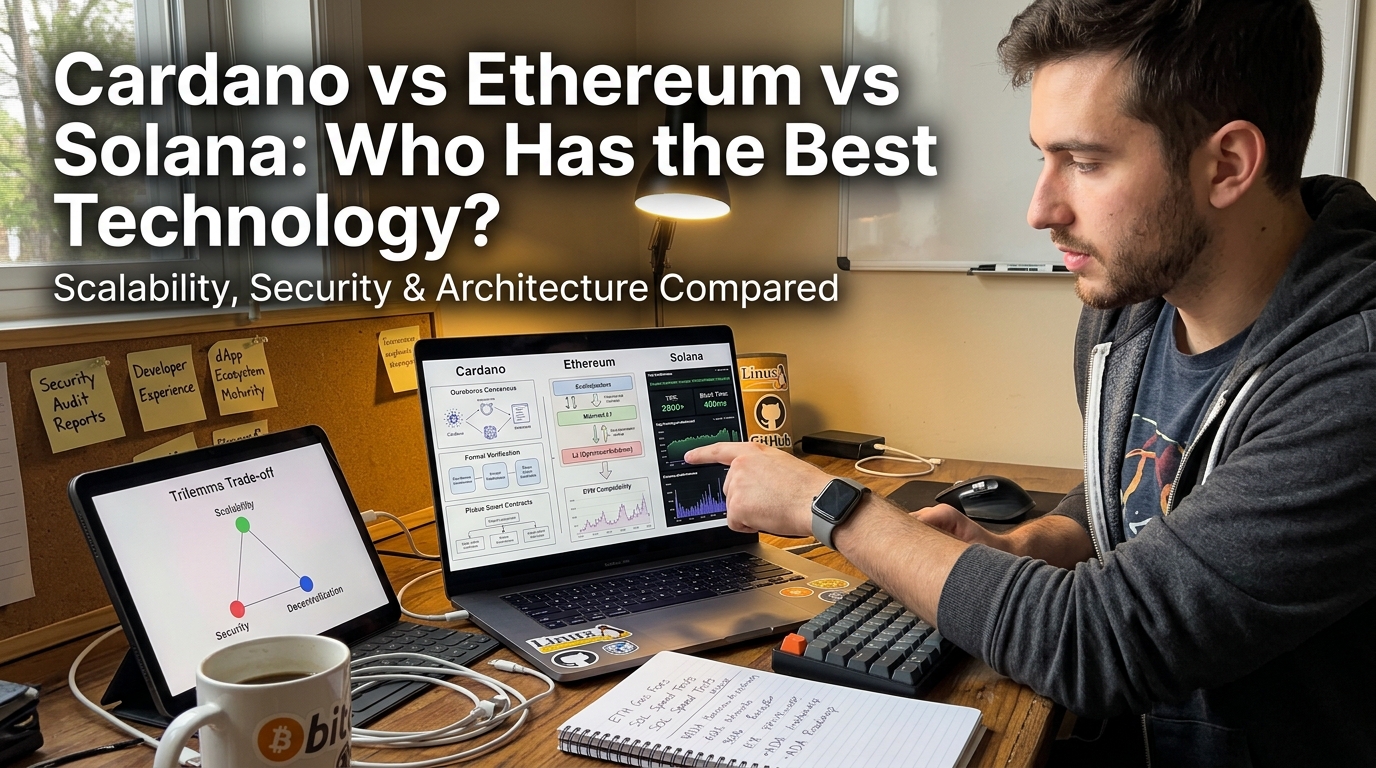
Cardano, Ethereum, and Solana are three of the most important blockchain networks in crypto. Each one takes a different approach to speed, security, scalability, and adoption, which is why investors and builders often compare them side by side.
If you are trying to decide which blockchain has the best technology, the answer depends on what you value most. Ethereum leads in ecosystem maturity and DeFi, Solana leads in speed and low fees, and Cardano stands out for its research-driven design and focus on long-term stability.
Quick Answer
There is no single winner for every use case. Ethereum has the strongest overall ecosystem, Solana has the best performance for fast and low-cost transactions, and Cardano has one of the most disciplined architectural approaches in the crypto industry.
If your priority is adoption and liquidity, Ethereum is the leader. If your priority is speed and cheap transactions, Solana is hard to beat. If your priority is formal design, peer-reviewed development, and a conservative approach to blockchain engineering, Cardano is the standout.
What Each Blockchain Is Built For

Ethereum was the first major smart contract platform and remains the foundation of much of decentralized finance, NFT activity, and Web3 infrastructure. It is the most established blockchain for developers who want access to the largest user base and the deepest liquidity.
Solana was built for high throughput and low transaction fees. It is especially popular for consumer apps, trading, gaming, and fast-moving decentralized applications where performance matters most.
Cardano was designed with a research-first philosophy. It emphasizes security, formal verification, sustainability, and a slower but more deliberate development process.
Technology Comparison
| Category | Ethereum | Solana | Cardano |
|---|---|---|---|
| Consensus model | Proof of Stake | Proof of History + Proof of Stake | Ouroboros Proof of Stake |
| Main strength | Adoption and ecosystem depth | Speed and low fees | Research-driven security |
| Fees | Higher on the base layer | Very low | Moderate |
| Developer ecosystem | Largest and most mature | Fast-growing | Smaller but active |
| DeFi adoption | Dominant | Strong and growing | Still developing |
| Best for | DeFi, institutions, long-term network effects | Payments, trading, consumer apps | Security-focused blockchain design |
Ethereum: The Most Mature Ecosystem
Ethereum remains the most important smart contract blockchain because of its massive developer base, broad integration with wallets and applications, and long history as the center of decentralized finance. It has the strongest network effects in the industry and continues to be the default choice for many serious blockchain projects.
Its biggest drawback is cost on the base layer. Ethereum can become expensive during periods of congestion, which is why Layer 2 networks have become such an important part of its scaling strategy. Even so, its combination of trust, liquidity, and adoption keeps it at the top of the smart contract market.
Solana: The Speed Leader
Solana is the blockchain people choose when speed and cost matter most. It is designed to handle high transaction volume with very low fees, which makes it attractive for trading platforms, payments, gaming, and consumer-facing applications.
Its main advantage is user experience. Transactions are fast, inexpensive, and efficient, which gives Solana an edge in applications where delays would hurt adoption. The tradeoff is that some users still view it as less decentralized and more operationally demanding than Ethereum or Cardano.
Cardano: The Research-First Chain
Cardano is different because it was built around academic research and peer-reviewed development. It focuses on security, sustainability, and structured upgrades rather than rushing features to market. That makes it one of the most carefully engineered blockchain projects in crypto.
Supporters believe this approach gives Cardano a long-term advantage because the network is designed to avoid mistakes that can weaken security or create technical debt. Critics argue that the pace of growth has been too slow and that adoption has lagged behind competitors. Both views are fair, which is why Cardano remains one of the most debated projects in the space.
Speed and Fees
When it comes to transaction speed and cost, Solana has the clearest advantage. It is built for high throughput and low fees, making it ideal for applications that need fast confirmation and a smooth user experience.
Ethereum is slower and more expensive on its base layer, though Layer 2 scaling has helped reduce costs for many users. Cardano sits somewhere in the middle on fees, but it does not match Solana's transaction performance or Ethereum's ecosystem depth.
Developer Ecosystem
Ethereum has the largest and most mature developer ecosystem in blockchain. That matters because the best technology is not only about design — it is also about tools, documentation, integrations, liquidity, and the number of projects building on the chain.
Solana has become a major destination for developers who want speed and consumer-scale applications. Cardano has a committed community and a technically focused developer base, but its ecosystem is still smaller than the other two.
DeFi and Real-World Adoption
Ethereum leads the market in decentralized finance and remains the primary settlement layer for much of the crypto economy. It has the strongest liquidity, the widest support from exchanges and apps, and the highest trust among institutions.
Solana has emerged as a strong competitor in DeFi and consumer apps, especially where low fees and fast execution create a better user experience. Cardano has made progress, but its DeFi ecosystem is still much smaller and needs stronger adoption to compete at the same level.
Which Blockchain Has the Best Technology?
If “best technology” means the strongest combination of adoption, tools, and real-world utility, Ethereum wins. If it means the fastest and cheapest network for everyday transactions, Solana wins. If it means the most careful and research-driven blockchain design, Cardano wins.
The right answer depends on what kind of technology matters most to you. Investors who want the safest large-cap infrastructure play usually favor Ethereum. Traders and users who want speed often prefer Solana. Long-term believers in academic blockchain engineering often point to Cardano.
Investment View
From an investment perspective, these three assets serve different roles. Ethereum is the most established and may be seen as the core smart contract holding. Solana is the higher-risk, higher-growth option. Cardano is the patient long-term bet built on execution, governance, and technical discipline.
That means this is not really a question of which blockchain is “good” or “bad.” It is a question of which network fits your goals, time horizon, and risk tolerance.
FAQ
Is Cardano better than Ethereum?
Cardano has a cleaner research-first design, but Ethereum has far more adoption, liquidity, and DeFi activity.
Is Solana better than Ethereum?
Solana is faster and cheaper, but Ethereum is more established and has the strongest ecosystem.
Which blockchain is best overall?
There is no single best blockchain. Ethereum wins on ecosystem, Solana wins on speed, and Cardano wins on structured design.
Which is best for long-term investing?
That depends on your strategy. Ethereum is the most established, Solana is the fastest-growing style bet, and Cardano is the most patient long-term thesis.
Conclusion
Cardano, Ethereum, and Solana each represent a different vision of what blockchain technology should be. Ethereum is the ecosystem leader, Solana is the performance leader, and Cardano is the research leader. The best choice depends on whether you care most about adoption, speed, or technical discipline.
For investors and readers, the smartest approach is not to ask which chain is perfect, but which chain is best aligned with your needs.
